Seareport
- Name: Seareport
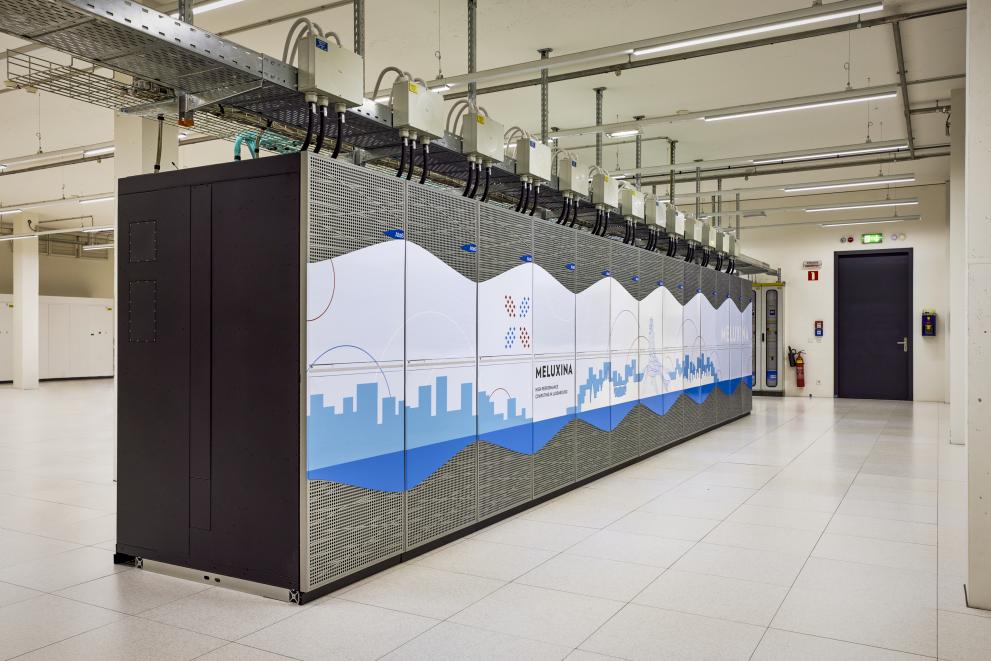
- EuroHPC machine used: MeluXina
- Topic: Earth and related environmental sciences
Overview of the project
The SeaReport project advances the European Commission JRC’s global metocean modelling system by integrating state-of-the-art hydrodynamic frameworks with EuroHPC resources. As climate change intensifies extreme coastal events, accurate and timely storm-surge predictions are essential for protecting coastal communities. Through EuroHPC support, we continue to improve the scalability and computational efficiency of our global baroclinic surge models, enabling higher spatial resolution, enhanced physics (including tide–surge interaction, Self Attraction and Loading and 3D processes) and improved simulations of coastal inundations. The project, currently in pilot phase, acts as a technology enabler, leveraging global 3D baroclinic simulations to provide situational awareness on coastal-related risks. By fostering open-source collaboration, we aim to democratize access to advanced hydrodynamic modelling tools and support the scientific community in tackling urgent environmental challenges.
How did EPICURE support the project and what were the benefits of the support?
“We contacted the EPICURE team to address a scalability bottleneck in our global hydrodynamic simulations. The model exhibited a communication wall at approximately 1024 MPI tasks, largely due to the overhead of collective communications in the solver. This limitation was critical: our nominal “production-like” configuration requires 3000 CPUs and a 24-hour walltime to deliver one month of results. The EPICURE experts identified the communication bottlenecks and improved the scalability by integrating NVIDIA’s HPC-X toolkit with optimized collective operations. This allowed the model to efficiently scale to several thousand tasks and removed the MPI communication saturation we had previously encountered.
With the optimizations provided by EPICURE:
- We can now scale well beyond 1024 cores, enabling higher model complexity (including switching to 3D baroclinic) and increased spatial resolution.
- Model runtime has been significantly reduced, enhancing our ability to perform large ensemble simulations and improve forecast skill.
- Computational resources are used more efficiently, lowering both runtime and energy consumption.
This offers substantial benefits and perspectives for operational and research-oriented global surge predictions.” – Thomas Saillour
Additional references
Thomas Saillour, Peter Salamon, Evangelos Voukouvalas, Sébastien E. Bourban, Giovanni Cuomo: Support for global models and integration of TELEMAC in a Python-based ecosystem. In: Proceedings of the XXXth TELEMAC User Conference, Chambéry, 8–9 October 2024. https://hdl.handle.net/20.500.11970/114351
Thomas Saillour, Panagiotis Mavrogiorgos and Saeed Moghimi. Collaborative efforts in global surge prediction: NOAA’s STOFS2D and JRC’s Seareport models intercomparison, 4th International Workshop on Waves, Storm Surges and Coastal Hazards, Santander, 22nd of September 2025. http://www.waveworkshop.org/18thWaves/Program.htm#C
Contact the project:
- Thomas Saillour (thomas.saillour@ec.europa.eu)
- Panagiotis Mavrogiorgos (panagiotis.mavrogiorgos@ext.ec.europa.eu)