Large-Eddy Simulations of Supersonic Air Intakes
- Name: Large-Eddy Simulations of Supersonic Air Intakes
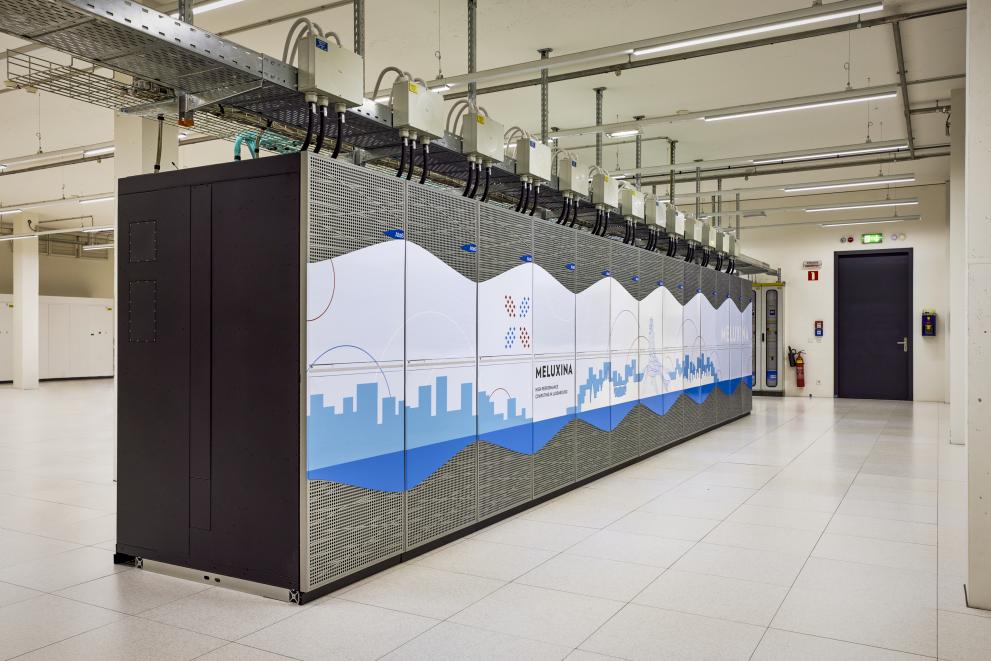
- EuroHPC machine used: MeluXina
- Topic: Mechanical engineering
Overview of the project
Aerobic propulsion systems require sufficient airflow through the engine to operate at nominal conditions. Design of the air intake then plays a key role in the performance of the propulsion system. This is particularly true in the supersonic flight regime where the incoming flow must be decelerated before entering the core of the engine. In optimal aerodynamic performance conditions, the inlet always operates at the near-critical condition characterized by a back-pressure-induced terminal shock standing near the duct throat. However, the basic geometry optimization for stationary flight conditions does not tackle the persisting tendency to inflow instabilities in the transient phases of engine and inlet operation. Off-design conditions may then promote strong instabilities known as the “buzz phenomenon” that can be a great threat to air-breathing supersonic vehicles.
This project proposes to broaden the knowledge of unsteady supersonic phenomena occurring in supersonic air intakes with the aim of improving design methods in the field of supersonic propulsion. Understanding the unsteady features of these configurations will lead to predictions of the performance and operating limits of high-speed propulsion systems. A final objective is also to provide keys for designing bleeding devices to control and avoid these detrimental unsteady flow phenomena.
How did EPICURE support the project and what were the benefits of the support?
Large-Eddy Simulations of Supersonic Air Intakes project requested support for code optimization, more precisely intra-node optimization with an attention to the vectorization and the proper memory usage, exploiting data locality, as the application is memory-bounded. A workforce team comprising experts from Luxprovide and JSC was assembled by EPICURE for a period of two months to work on that project.
The EPICURE support confirmed the strong parallel performance of the code, and that a deeper dive into node-level optimizations is required for achieving better performance.
Additional references
Deleu Samuel, Sanchez del Rio, Alvaro, Gojon Romain, Gressier Jérémie, Jamme Stéphane, Boundary layer tripping strategies for supersonic air
inlet applications. 2024, International conference proceedings, 13th International Symposium on Turbulence and Shear Flow Phenomena, June
25–28, Montréal, Canada.
Frey, Matthias, Jamme Stéphane, Gojon Romain, Fiore Maxime, Gressier Jérémie, Large Eddy Simulation of the control of the inlet buzz
phenomenon in a supersonic air inlet. 2023, International conference proceedings, 34th International Symposium on Shock Waves, July 16-21,
Daegu, Korea.
Hammachi Riwan, Gojon Romain, Fiore Maxime, Gressier Jérémie, Jamme Stéphane, LES analysis of a supersonic air inlet experiencing buzz
phenomenon. 2022, 12th International Symposium on Turbulence and Shear Flow Phenomena, July 19-22, Osaka, Japan.
Contact the project:
- Stéphane Jamme (stephane.jamme@isae-supaero.fr)